Volleyball Strategies for Skills Training - How to Improve Skills?
Volleyball strategies for skills training. Read about training methods to improve your skill level.
Volleyball Strategies for Skills Training
What is Three Point Serve Receive in Volleyball?
Recently when discussing about volleyball strategies and “how to play volleyball” we had a debate over a controversial topic which always divides opinions.
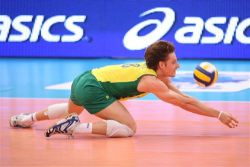
We were discussing about the common passing technique in which
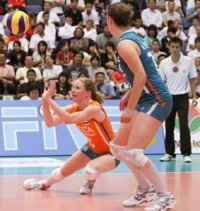
you set up your other knee on the floor when passing a low ball.
Coaches may call it 3 point serve receive technique (right foot + left
foot + knee =3).
This three point serve receive technique has become a very
common passing technique in high level international volleyball
matches. Despite the fact that top players are using it, there are some
coaches and players who criticize this passing technique.
Which side you belong to? Could you pass your knee on the ground?
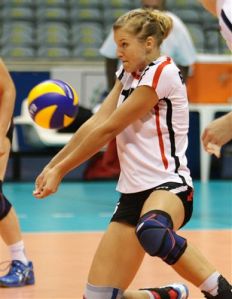
Many coaches feel you should never put other knee on the ground when passing. Some agree it is useful - to bail you out in some situations - but still you definitely shouldn’t practice it.
Volleyball people who support the technique say it will make passing position more stable and help players to keep better balance. Passers suppose to use the three point passing technique when they are forced to pass the low ball – when the ball is near the floor.
There may not be a clear right or wrong answer in this issue. Both sides have good arguments.
However, the fact is this technique is widely used in
volleyball.
Clearly staying on both feet is more advantageous, if the player needs to prepare to swing a fast tempo set after the pass.
On the other hand, if the ball is extremely low and near the floor level, “knee on the ground” gives a stable and more balanced position to the passer.
To read more about this 3 point serve receive technique, go to
the volleyball skills section and controversial serve receive
technique.
Volleyball Strategies to Learn Volleyball Skills – How to Improve Technical Skills?
Volleyball Training Strategies - How to Learn to Play Volleyball?
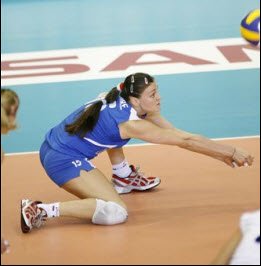
As you probably figured out, we are in favor of the 3 point passing technique above.
We do think the passer should use the “standard” passing form whenever possible – but in the training we practice other techniques also because those are used in the matches regularly.
In volleyball training our goal is to increase players’ skill levels by practicing techniques far beyond what is considered “the norm”.
Volleyball Strategies - How to Use Untraditional Volleyball Training Strategies To Learn Skills?
Volleyball Training Strategies - How To Improve Passing Skills?
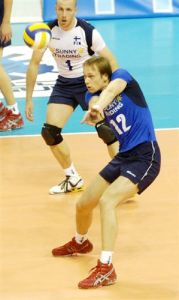
Passing two feet on the ground and keeping the ball directly in front of the player is "the standard" passing form. In addition to it, we think it is beneficial to train other techniques also, because players need to use those in the matches constantly.
If the ball is constantly contacted on the left or right side of the body in the match, we should also practice it, right?
When we practice passing, we do lots of repetitions in which players contact the ball on the side of the body – in opposition to pass the ball in front, which is the norm.
We have experienced this clearly improves ball control and passing skills.
Volleyball Training Strategies - How To Improve Spiking Skills?
Another example of this untraditional training would be “tooling” the block, in other words "swiping" the block or “using the block” to score a point.
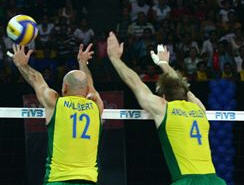
Volleyball players are usually trained to hit powerful spikes straight down to the court or off the defenders arms - while "using the block" won't get trained very much at all.
We train "tooling" very heavily - just because it occurs in
the match as often as other spikes.
Often we make up drills in which
players are required to get a kill by "using the block" – other kills
are not allowed.
Volleyball Strategies - Why do We Use Untraditional Training Methods?
There are coaches who want to teach players only the “standard techniques”, “the norm”. (For example: "We don't want to teach 3 point serve receive technique, because I want players to stay on their feet.")
We think it is the best practice to train all the techniques which are used in matches – not just the perfect, standard ways of doing things.
And it is not just our opinion - it is also based on the
biomechanics and science of learning.
If you want to perform specific actions in the match, you need to
practice those actions.
We
build motor skills as we repeat specific movements.
For example
outside hitting requires different motor skills than right side
hitting. If we learn one of them, it doesn't mean we
automatically learn the other one too. Motor skills for those
two are different, so we need to practice them both.
So, if you want to learn i.e. open hand digging above your
head, you have to practice it. Players won't learn by hearing
it. No matter how many times the coach tells "you should dig
higher balls by open hands", most likely players won't learn unless it
is repeated in practice.
To conclude, you got to practice all the
techniques players use in the matches - no matter how
untraditional those are.
Conclusion for Volleyball Strategies in Skills Training

Every coach develops his/her own training style and training
methods – depending on the team they coach.
We have
experienced a great progress with the drills above when the primary
goal has been to develop skill levels of the players.
More conventional
coaching methods could work well for other coaching goals.
However, if the coach uses more conventional coaching methods, it should not automatically mean resisting change or denying new methods without trying.
It is good to remember the common denominator for the most successful coaches is they are constantly willing to learn new - they feel they are students of the game all the time, no matter how experienced they are.
Like this page:


