Basic Volleyball Rules - Cases
Explore basic volleyball rules cases which help you to understand volleyball rules through real game situations.
We present volleyball rules cases for libero attack, joust, back row block, setter's offense, blocking etc.
If you are looking for easy to understand, simple rules go to Basic Volleyball Rules section. These following cases are more complex.
Basic Volleyball Rules Cases
Volleyball Rules Scenario: Joust - Volleyball on the plane of the net

A joust occurs in the situation in which the ball is on the plane of the net - on the neutral zone in which both teams are allowed to play the ball.
A joust occurs when two players simultaneously touch the ball on the neutral zone above the net.
Basic Volleyball Rules - Case 1: Joust - Blocker vs. Blocker
Rule: Previously referee used to call replay if the ball stops between players, but perception of the rule has been changed. The play supposed to continue, even if the ball stops between the players.Lengthened contact when doing the joust is legal. (Similar longer contact when attacking the ball is a fault.)
How to Win Volleyball Joust?
In order to win the joust the player needs to be "aggressive and strong".Extend your arms, "lock your elbows and shoulders". It is extremely important to keep your abs "tight".
Keeping your core, the middle body "tight" helps you to keep the ball "stabile" when opponent is pushing it. So actually the key is to "hold" to keep the ball stabile, instead of just pushing the ball forward.
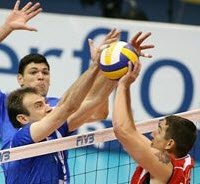
"Hold" the ball and don't give even an inch to your opponent. If you just attack and push to the ball quickly to the hands of the opponent, you'll likely lose the joust.
Most often the player who just pushes the ball loses against the player who understands just to "hold the ball steady".
The key is to "hold" the ball with all your power as long as you can. By following the "hold" principle, you often win even if you have only one hand on the joust.
Important: We used the word "hold", instead of "push", so you understand it is important have a long contact to the ball. You do push the ball, but the most important thing is to "defend" from your opponent' push and having a long and steady contact to the ball.
How to practice volleyball joust?
You can test and practice the joust without a net, placing the ball between the player's hands. You'll notice now much easier it is to "defend" and "hold" the ball, when other person is trying to push it hard.Basic Volleyball Rules Case 2: Joust - Blocker vs. Blocker
This situation is more complex, but can be executed by extremely skilled players. 
How to Win Volleyball Joust? - Another Way to Win the Rally
When two players are simultaneously touching the ball above the net sometimes you are in the bad position to push the ball to the opponent' side.In that situation it would be necessary to "secretly" pull the ball to your own side OUTSIDE THE BOUNDARY LINES.
In other words let the opponent push the ball to your side, but direct it outside the lines.
The reason why you win the joust
The guidelines for refereeing state, if two players are simultaneously pushing the ball and the ball goes outside the lines, the referee should judge "the ball went out because the offensive side pushed it out".
Therefore, if you are very skilled and able to "direct" that ball outside your own boundary lines, you suppose to win the ball to your team.
Volleyball Rules Related Pages
If you were looking for plain and simple Rules of Volleyball, go to Basic Volleyball Rules section.Rules of Volleyball- Cases How to Use Rules for Your Advantage?
Rules of VolleyballRead about back row setter vs. blocker in the net. How to win the rally when the volleyball is above the net?
Volleyball Game Rules
Read about volleyball libero rules. Read more about setter vs. blocker tips.
Like this page:


